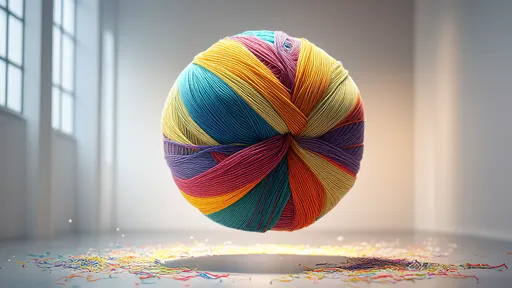
The humble sweater, once a staple of winter wardrobes, often meets a tragic end—discarded in closets or dumped in landfills when its stitching loosens or styles change. But a quiet revolution is brewing in textile recycling labs and grassroots knitting circles, where discarded woolens are being reborn as everything from insulation materials to high-fashion statement pieces. This isn’t just upcycling; it’s a full-fledged fiber renaissance.
At the heart of this movement lies a simple yet radical idea: wool, cotton, and even synthetic blends can be “un-knit” and respun indefinitely. Traditional recycling methods often degrade fabric quality, but new mechanical and chemical processes now separate fibers without breaking them down. In Italy, a startup called Manteco has perfected a method to shred old sweaters into raw wool tops, which are then re-spun into yarn indistinguishable from virgin material. The result? Luxury brands like Prada and Jil Sander are quietly incorporating these regenerated fibers into their collections.
Meanwhile, in Chile’s Atacama Desert—where 59,000 tons of fast-fashion castoffs accumulate annually—engineers are experimenting with sweater-derived felt for building insulation. The crimped structure of wool fibers creates millions of tiny air pockets, offering better thermal regulation than fiberglass. “A moth-eaten cashmere sweater can insulate a home just as well as it once warmed shoulders,” notes textile scientist Dr. Elena Marquez, whose team recently lined an entire refugee housing unit with repurposed knitwear.
The DIY community has embraced this ethos with equal fervor. Across social media, hashtags like #UnravelRebuild showcase crafters who painstakingly deconstruct thrift-store finds. Some harvest intact yarn for new projects; others incorporate unraveled sections directly into patchwork designs. Brooklyn-based artist Lydia Jensen recently exhibited a 12-foot tapestry woven entirely from sweater sleeves, their original ribbing patterns forming unexpected geometric rhythms. “Every unraveled stitch tells a story,” she says. “The stretched-out elbows, the darned holes—they’re like tree rings showing a garment’s life.”
Even industrial-scale operations are finding creative applications. Swedish company Re:Wool compacts shredded sweaters into acoustic panels that absorb 30% more sound than conventional materials. Their biggest client? Recording studios eager to dampen echoes without petroleum-based foams. Meanwhile, Australian researchers developed a technique to blend sweater fluff with mycelium, creating a leather-like material used for handbags and upholstery.
Challenges remain, particularly with blended fabrics. A typical 50/50 wool-acrylic sweater requires sophisticated separation methods to avoid downcycling. But innovators like Taiwan’s Singtex have pioneered coffee-ground-infused polymers that bind to synthetic fibers, allowing cleaner extraction. Their W2E (Waste to Energy) jackets—made from 70% recycled sweater content—now outfit entire university athletic teams.
Perhaps the most poetic transformation occurs in Japan, where Boro mending techniques intersect with fiber recycling. Artisans combine scraps from hundreds of sweaters into intricate patchworks, deliberately highlighting repairs. What was once considered poverty-driven necessity is now haute couture, with reconstructed cardigans fetching four-figure prices at Tokyo’s Dover Street Market.
As consumers increasingly reject disposable fashion, the sweater’s afterlife grows more inventive. From Milanese runways to Chilean construction sites, the message is clear: a garment’s first life is just the beginning. With every unraveled thread respun, we’re rewriting not just textile economics, but our relationship with objects themselves—one stitch at a time.
By /Jul 30, 2025
By /Jul 30, 2025

By /Jul 30, 2025
By /Jul 30, 2025

By /Jul 30, 2025

By /Jul 30, 2025

By /Jul 30, 2025

By /Jul 30, 2025

By /Jul 30, 2025

By /Jul 30, 2025

By /Jul 30, 2025

By /Jul 30, 2025
By /Jul 30, 2025

By /Jul 30, 2025

By /Jul 30, 2025

By /Jul 30, 2025
By /Jul 30, 2025

By /Jul 30, 2025

By /Jul 30, 2025
By /Jul 30, 2025
