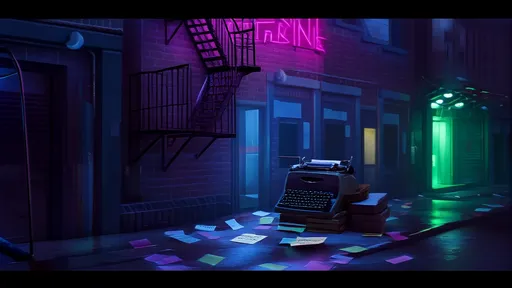
The glow of neon has always held a peculiar magic—a flicker of nostalgia, a whisper of the past, yet an undying presence in the modern night. Neon Inertia, or "neon inactivity," as some might clumsily translate it, is anything but inert. It pulses, it breathes, it writes love letters to the darkness in hues of electric crimson and cobalt. This is not just about gas trapped in glass; it’s about the way cities remember their own stories, how light becomes language.
Walk through any metropolis after sundown, and you’ll see it—the neon arteries of urban life. Tokyo’s Shinjuku, Hong Kong’s Tsim Sha Tsui, the flickering remnants of Times Square before LEDs took over. These tubes of light are relics of a bolder aesthetic, one that refused to apologize for its garishness. There’s something defiant in their persistence, a refusal to fade even as newer, cheaper technologies muscle in. Neon doesn’t just illuminate; it declares. It’s the difference between a whisper and a shout across a crowded room.
The science behind neon’s glow is deceptively simple. Fill a sealed tube with rarefied gas, apply high voltage, and watch as atoms collide, shedding photons in their wake. Yet the artistry lies in the bending—the way glass must be heated, twisted, coaxed into cursive script or the silhouette of a martini glass. Each curve is a battle against fragility, a negotiation between the rigidity of physics and the fluidity of human imagination. The best neon signs feel alive, as if they might slither off their mountings and slide into the alleyways when no one’s looking.
But neon’s allure isn’t merely visual. There’s an auditory texture to its presence—the faint, almost subliminal buzz of transformers, the occasional crackle of aging electrodes. These sounds form the bassline of the nocturnal symphony, harmonizing with the distant wail of sirens and the murmur of late-night conversations. To stand beneath a buzzing neon sign is to stand inside the ribcage of the city, listening to its heartbeat.
What’s often overlooked is neon’s role as cultural scribe. The signs above dive bars, pawn shops, and 24-hour diners are more than advertisements; they’re glyphs of collective memory. The pink flamingo of a vanished motel, the stuttering "Vacancy" of a roadside lodge—these are the runes by which we navigate the mythology of the American highway. In Asia, neon’s lexicon shifts: the pulsing kanji of pachinko parlors, the dragon-shaped tubes guarding temple districts. Light becomes dialect.
Yet for all its romance, neon is a dying craft. The artisans who once bent glass with blowtorches and intuition are aging, their skills evaporating like the mercury in vintage signage. Municipalities ban neon for its energy appetite, landlords replace it with soulless LED panels, and the younger generation scarcely notices the difference. We’re losing not just a lighting technology, but a form of storytelling—one where every flicker carried subtext, where the slow death of a sign’s glow mirrored the twilight of the businesses it championed.
Perhaps that’s why neon persists in our collective imagination. Films like "Blade Runner" or "Drive" weaponize its glow to evoke melancholy futurism. Photographers chase its reflections in rain-slicked streets, hunting for that perfect interplay of light and liquid. Neon has transcended its material form to become shorthand for longing—for cities that never sleep, for loves that burn too bright to last. The tubes may grow dimmer, but the afterimage lingers on our retinas.
In the end, neon’s true inertia isn’t chemical. It’s the way it resists erasure, how it stains the night long after the current is cut. The next time you pass one of those surviving signs—maybe a weathered "Cocktails" or a stubbornly cheerful "Open 24 Hours"—pause. That glow isn’t just photons. It’s a love letter, written in fire and gas, addressed to anyone still willing to look up from their phone and remember that darkness deserves its own poetry.
By /Jul 30, 2025
By /Jul 30, 2025

By /Jul 30, 2025
By /Jul 30, 2025
By /Jul 30, 2025

By /Jul 30, 2025

By /Jul 30, 2025

By /Jul 30, 2025
By /Jul 30, 2025

By /Jul 30, 2025
By /Jul 30, 2025

By /Jul 30, 2025

By /Jul 30, 2025
By /Jul 30, 2025

By /Jul 30, 2025
By /Jul 30, 2025
By /Jul 30, 2025
By /Jul 30, 2025
By /Jul 30, 2025

By /Jul 30, 2025
