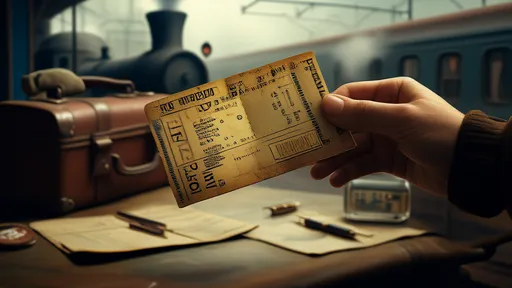
The well-worn train ticket in your pocket tells more than just your destination—it carries the weight of journeys taken, the anticipation of arrivals, and the melancholy of goodbyes. Over time, the crisp edges soften, the ink fades, and the paper develops creases that map out your travels like topographic lines. These folds are not just accidental wrinkles; they are the physical imprints of movement, the silent archivists of our wanderings.
Travel tickets, whether for planes, trains, or buses, begin their lives as pristine slips of paper or digital abstractions. But the physical ones, especially, bear the marks of human handling. The first fold often happens at the moment of purchase—a hasty tuck into a wallet or a pocket, an unconscious gesture that marks the beginning of a journey. Later, when inspected by a conductor or scanned at a gate, the ticket is unfolded, then refolded, each action adding another layer to its history.
The creases accumulate like memories. A deep vertical fold might signify a long-haul train ride where the ticket was kept safe in a breast pocket, pulled out only at checkpoints. Faint horizontal lines could hint at a hurried commuter, shoving the pass into a back pocket day after day. Some tickets are so thoroughly crumpled they resemble origami, their surfaces a patchwork of bends and ridges—evidence of restless hands, of being clutched during delays or nervously turned over while waiting.
There is an intimacy to these worn tickets that digital boarding passes lack. A smartphone screen does not crease, does not yellow with time, does not retain the sweat of a summer journey. The physical ticket, by contrast, becomes a relic, a tactile artifact of a specific moment in motion. It is a receipt not just for payment, but for experience.
Scientists and archivists have long known that paper retains the memory of how it has been handled. The fibers realign under pressure, creating permanent weak points where future folds are more likely to occur. In this way, a ticket’s creases are not random—they follow the logic of use, the patterns of human behavior. The more a ticket is handled, the more it conforms to the rhythms of its owner’s travels.
Some travelers deliberately preserve their tickets, smoothing them into scrapbooks or pinning them to bulletin boards as souvenirs. Others let them fade into oblivion, tossed into glove compartments or the bottom of bags. But even those discarded slips hold stories. A ticket stub found years later in an old coat pocket can trigger a flood of recollections—the weather on that day, the smell of the station, the face of a fellow passenger.
In an age where digital transactions dominate, the physical ticket is becoming a rarity. Yet there remains something profoundly human about the way we interact with these fragile documents. They are not just tools for transit; they are companions in motion, absorbing the small stresses and joys of getting from one place to another. The creases are the signatures of those journeys, the quiet testament to all the miles passed.
Perhaps that is why we hesitate before throwing them away. To discard a used ticket feels like erasing a piece of personal history. The folds are proof that we were there, that we moved through space and time, leaving behind nothing but these delicate, crumpled traces.

By /Jul 30, 2025
By /Jul 30, 2025

By /Jul 30, 2025
By /Jul 30, 2025

By /Jul 30, 2025

By /Jul 30, 2025

By /Jul 30, 2025

By /Jul 30, 2025
By /Jul 30, 2025
By /Jul 30, 2025

By /Jul 30, 2025

By /Jul 30, 2025
By /Jul 30, 2025

By /Jul 30, 2025

By /Jul 30, 2025

By /Jul 30, 2025
By /Jul 30, 2025
By /Jul 30, 2025

By /Jul 30, 2025
By /Jul 30, 2025
